Climate risk assessment. Resilient futures.
We exist to make the physical risk of climate change legible at the level it actually bites — one property, one roofline, one foundation at a time.
Built for the questions a postcode can't answer
Most climate risk information available to buyers, owners and lenders is aggregated at a suburb or postcode level. It tells you that an area floods — not whether this specific property, on this specific block, built to this specific standard, is likely to be affected.
Climate Remit was founded to close that gap. We combine hazard science with property-level design and construction detail to produce a report that reflects the asset in front of you, not the average of its neighbourhood.
Engineering-grade analysis, delivered simply
Our Climate Risk Engine draws on national and international hazard datasets, digital elevation models, soil and vegetation mapping, and historical weather records, then layers in the details of an individual property to calculate its exposure and vulnerability.
The output is written for people making real decisions — buying, selling, insuring, lending against or renovating a property — not just for specialists.
Grounded in the same science used for engineering and investment decisions
IPCC-aligned pathways
Hazard projections are modelled across present-day, mid-century and end-of-century time horizons, using IPCC AR6 climate models and SSP emissions scenarios.
Property-specific inputs
Construction type, elevation, age and design details are factored in, so two properties on the same street can receive different ratings.
Independent methodology
Our risk engine is not tied to any single insurer or lender's book of business — the analysis is built to be defensible on its own terms.
Principles behind every report
Rigor
Every rating traces back to a documented hazard model and a stated assumption — nothing is a black box.
Independence
We report what the data shows, whether or not it is convenient for a transaction.
Clarity
A report should be usable by a first-home buyer and defensible to an engineer, in the same document.
Access
Property-level climate data should not be a luxury reserved for large institutional portfolios.
How a report actually gets built
From address to resilience rating, every report follows the same documented process — hazard modelling, vulnerability analysis, exposure overlay and rating.
Read the full methodology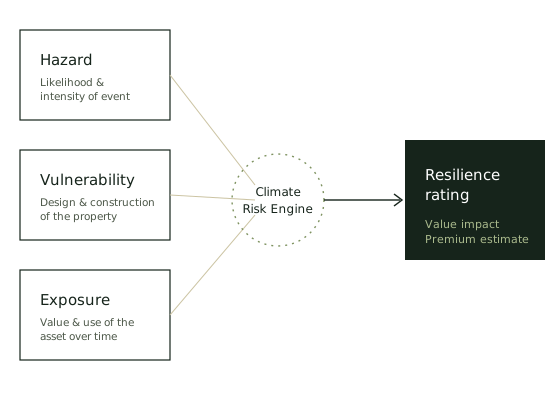
Get to know the risk behind an address
Whether you're assessing one home or a portfolio of thousands, our team can walk you through the right report for your situation.